|
| |
|
| |
| ||
|
||
|
| |
| ||
.gif) |
     Nation Politics World Business Technology Entertainment Sports  Nation: Supreme Court to Hear Challege of Managed Care Plans World: Iran's Young Voices of Change |
 Turnout May Be Key in S.C.  By Edward Walsh Washington Post Staff Writer Thursday, February 17, 2000; Page A01
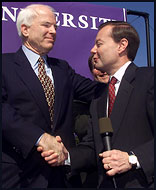
GREENVILLE, S.C., Feb. 16 –– Slugging it out in the final days before Saturday's South Carolina primary, George W. Bush and John McCain targeted key constituencies today as McCain picked up the endorsement of an important social conservative and Bush continued his assault on his rival with a barrage of negative television commercials. With their final debate here behind them, the two GOP contenders turned their attention to the question of voter turnout, the crucial factor in an election that polls continue to show as too close to call. The Arizona senator hopes to duplicate the magic he found among independent voters in New Hampshire two weeks ago, banking on another record voter turnout that would include a large number of independents to give him a chance to score a second stunning blow against his better-financed rival. But campaigning in a state that is considerably more conservative than New Hampshire, McCain also turned his attention to South Carolina's large Christian conservative community. Having secured the endorsement today of his former rival for the GOP nomination, Gary Bauer, McCain sought to reassure those voters that he shares their values on issues such as abortion and to undermine Bush in what is considered his South Carolina stronghold. Bush, meanwhile, reached out to the independents and moderate Republicans and Democrats whom McCain has targeted, saying that he would push for managed-care health reform in Congress. The Texas governor also aired a new television commercial attacking, among other things, McCain's record on campaign finance reform, the centerpiece of the Arizona senator's campaign. To finish off his expensive effort here, he has purchased 30-minute time slots in three media markets for the broadcast of an edited video of a South Carolina town meeting in which a relaxed Bush talks one-on-one with voters. At a noontime rally today on the campus of Furman University, Bauer, the conservative social activist whose own presidential campaign never took hold, called McCain the GOP's best chance "to end the era of Bill and Hillary and Al Gore" in November. Bill Kristol, editor of the Weekly Standard and a friend of Bauer's, said Bauer endorsed McCain in part because he is outraged by the negative tactics of two Bush supporters who have strong ties to the religious right. "I believe that Gary feels that he is trying to save the honor of religious conservatives because he believes Ralph Reed and Pat Robertson have behaved so dishonorably by being part of the Bush attack machine in South Carolina," Kristol said. Although his campaign had little impact on the race, Bauer retains a strong following among Christian conservatives, who form the bedrock of the Republican Party in this part of the state and who appear poised to give Bush their strong support. But McCain and his aides said they hope the Bauer endorsement would help buttress McCain's credentials as an antiabortion conservative and cut into Bush's expected majority among Christian conservatives. As he toured some of the most conservative parts of the state today, McCain was accompanied by Rep. Lindsey Graham (R-S.C.), who introduced McCain in almost messianic terms. "You're here because God wants you to be here," Graham told McCain. "We in South Carolina on Saturday can change the course of this country for the century. God has given us a great chance to rise to America's need." But three days before that crucial primary, McCain and his organization were looking today beyond South Carolina's conservative Christian Republican base for the votes that could propel him ahead of Bush. The formula worked in New Hampshire, where McCain won a narrow majority among GOP voters but swept to a decisive victory with the overwhelming support of independent voters. Independents may vote in the GOP primary in both states. But here, unlike in New Hampshire, McCain will not benefit from Election Day voter registration, which apparently enticed large numbers of young people to vote for the candidate portraying himself as the renegade challenging his party's establishment. Aboard his campaign bus, the Straight Talk Express, McCain said this morning that he was beginning to sense enthusiasm for his candidacy but acknowledged that "it hasn't reached the level of enthusiasm in New Hampshire." He also said that he was worried that the barrage of negative advertising that Bush is aiming at him "will depress the turnout" on Saturday. To boost the turnout, McCain plans to barnstorm across South Carolina from now until Saturday, holding rallies designed to generate voter enthusiasm, and not just among Republicans. The McCain campaign, which has very little institutional support in this state, has been scrambling to piece together an Election Day operation to turn out votes. McCain is targeting a particularly aggressive effort at veterans. He has set up special veterans committees in every county to run parallel with the campaign organization, and these former military men and women are conducting their own get-out-the-vote efforts. Terry Haskins, speaker pro-tem of the South Carolina House and one of the rare public officials backing McCain's bid, said the campaign has mobilized "hundreds and hundreds" of volunteers who will work the phones and drive elderly voters to the polls. To counter the barrage of anti-McCain phone calls being made to conservative radio stations, the McCain campaign is distributing a list of all talk shows in the state, with phone numbers, and is asking supporters to call the stations and respond to the chorus of McCain critics who have been calling in. McCain is also banking on antiabortion leaders in the state who are not supporting Bush to help dilute the get-out-the-vote effort of the South Carolina Right to Life Committee on behalf of the Texas governor. As part of the drive to woo Democrats and independents, the campaign is preparing to showcase two Democratic state senators, John Drummond and Phil Levintis, at public appearances and news conferences. Drummond has backed virtually every GOP presidential candidate since Ronald Reagan in 1980 and has been a leader of Democrats supporting GOP Sen. Strom Thurmond. In the state's heavily Democratic Jewish community, McCain's willingness to criticize Patrick J. Buchanan and his views questioning U.S. participation in World War II has been a source of strong appeal, and produced a substantial turnout at a synagogue in Columbia earlier this week. For the second day in a row, Bush sought to cut into McCain's support among independents, moderate Republicans and Democrats, airing a new ad charging McCain with making unfounded negative attacks as well as a 30-minute video showing Bush answering questions about his reform agenda. Questioned about reports that he already has spent $50 million, Bush said he is not worried that the campaign had about $20 million left at the end of January and tried to shift the focus to McCain, whose campaign, Bush said, needs to explain its own spending in South Carolina. "We have been fighting in every primary state, we're on plan, and I think I've got a good chance of winning," Bush said, explaining that his campaign's spending has been on track with projections. Bush suggested that McCain has circumvented the spirit of campaign finance laws by exceeding the state's spending cap. Because McCain takes federal matching funds, while Bush does not, he must live within spending limits--in this state, about $1.6 million. The Bush campaign estimated that the senator has spent about $2.8 million on television and radio alone. "A candidate ought to conform to the rules here," Bush said. "Senator McCain ought to explain if he's broken the spending caps." McCain spokesman Howard Opinsky insisted that McCain is abiding by the FEC rules, saying "one can understand how the Bush campaign has failed to understand how the federal matching system works. They have chosen to completely blow off the spending limits and the federal matching system." Bush, who campaigned around the southeastern part of the state today, said he was happy about his performance in Tuesday night's GOP debate and that he felt confident he would win. On display this morning at an event in Hilton Head was Bush's now-famous penchant for garbled sentences and non sequiturs. He told a crowd of several hundred people this morning: "If you're sick and tired of the politics of cynicism and polls and principles, come and join this campaign." Staff writer Terry M. Neal contributed to this report. |
| |
.gif) | |
| | ||